Biomechanics of joints
The connection between bones in the human body occurs in two ways - mobile and fixed. A fixed connection does not allow movement between the bones and is located in places where the distance between the connecting bones should not change or this change should be minimal. The main biomechanical task of this type of connection is passive resistance to external or internal forces acting on the musculoskeletal system.
Movable connection is made through joints. Joint structures create conditions for movement between bones when forces are applied to them. These forces can be internal (generated by the muscle's own contraction) or external.

The main structures of the joint are the articular surfaces, the articular cartilage, the joint capsule and the articular ligaments. Each of them has its own biomechanical properties.
The shape of the joint surfaces determines the movement in the joint. They can be compared to parts of geometric bodies - a sphere, an ellipse, a cylinder. One articular surface is convex and the other concave. The correspondence between the articular surfaces is called congruence.
Articular cartilage covers the articular surfaces and, from a biomechanical point of view, is a viscoelastic structure that absorbs a large part of the compressive forces occurring between the articular surfaces. This is due, on the one hand, to the structural features of the intercellular substance of hyaline cartilage, which in most cases is articular cartilage, and on the other hand to its ability to receive part of the joint fluid inside. The articular cartilage not only absorbs the pressure forces, but thanks to the structural features of the intercellular substance, it helps to distribute them evenly.
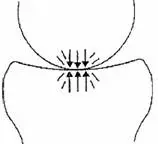
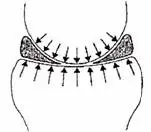
Even distribution of pressure in the presence of articular cartilage and uneven distribution in its absence.
Another important feature of articular cartilage is its extremely smooth surface, which reduces frictional forces during joint movement. Sliding between two articular cartilages is comparable to the sliding of an ice block on an icy surface.
The joint capsule is captured at the edges of the articular surfaces and also has biomechanical properties that can be considered in two directions.
The first is due to the outer layer of the joint capsule, made up of bundles of coarse collagen fibers. The exceptional strength of collagen in resisting tensile forces is known. During movement, forces arise in the joints that tend to move the joint surfaces away from each other. It is the outer layer of the joint capsule (called fibrous, because of the collagen fibers that make it up) that is one of the structures that resists these forces and preserves the integrity of the joint.
The second direction is related to the function of the inner layer of the joint capsule - the synovial. It releases synovial fluid into the joint. Its composition contains substances due to the ability to reduce the frictional forces between the articular cartilages covering the joint surfaces. In addition, the joint fluid forms a thin layer between the joint surfaces, which also absorbs some of the compressive forces that occur during movement.
Joints (ligaments) are structures that are also made of collagen fibers and are transferred between the bones forming the joint. They ensure the stability of the joint by resisting the forces causing non-physiological movements in the joint. Since this counteraction occurs through the passive mechanical strength of the connections, it is referred to by the term "passive stabilization of the joint".
It is of particular importance for the biomechanics of joints to classify the movements that take place in them.